 What happens when a sensitive hermit who lives alone decides to spend a week in a field with 4000 people?
She prepares her inner state and reviews her social skills – extra diligently, ha ha.
Yes, you guessed it. I’ve decided to go to a big summer festival, and for me it’s the boldest social move I’ve made in years.
This post shares a useful discovery and a tool for saying “no” that came FROM my preparations for the festival.
The thing I’ve been apprehensive about
As the festival approaches, what I found myself dreading is the prospect of increased intensity in interactions.
Being around so many people will inevitably put me more in contact with the human propensity for drama, including pushing into others’ energy which is my least favourite thing in life.
People everywhere 😉 could easily turn into an introvert’s nightmare, unless that is she remembers her natural alignment!
Natural alignment = respect for own limits + requirements in order to be well and of best use to others
What my sensitive, largely open energy means is that I naturally have a limit for how much I can be AROUND intense interactions.
To respect my wellbeing and to be of use to the collective, I need to be very discerning about what to volunteer to take part in and when to walk away.
So I’ve been wondering how to boost my ability to represent my boundaries while in the festival community, and how to remember to say “no” alongside my natural openness.
I’d like to be open AND to prevent entanglement into reactive exchanges.
Here, I’m feeling deeply moved.
While I was articulating my questions about this last week, Life sent me beautiful support to come up with a resource just for that.
Handy crib sheet for me and you
I’ll be taking this resource – the crib sheet shown below – to the festival with me.
I feel greatly calmed already from having it. I’ll keep it on me, in my phone case, as a prompt for self-representation.
It seems too good to only keep to myself, so you’re welcome to use it when you want to support yourself to say “no” and do so kindly.
Let me show you the crib sheet and then I’ll tell you why I find it so potent.
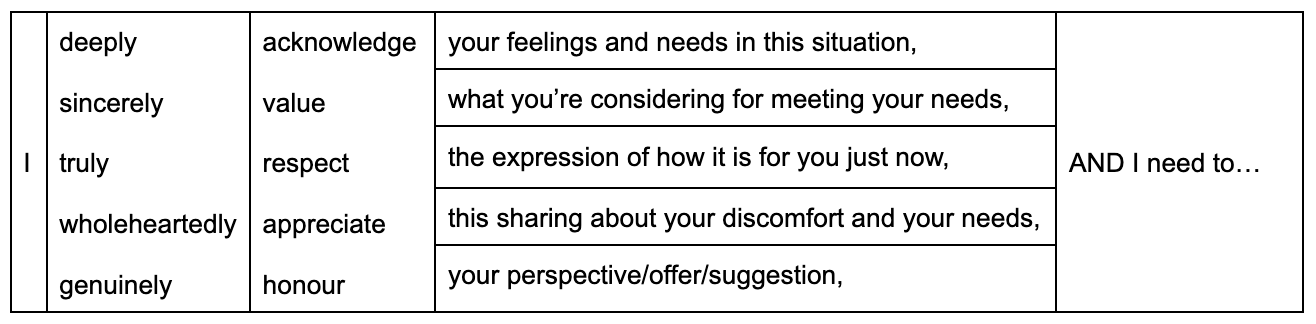
Can you see how the crib sheet works?
The format – a box that allows you to construct many sentences from a selection of options – comes from my days of teaching English as a foreign language.
In this case too the purpose is to learn a new language – not a foreign language but rather a sovereign language.
The reason I and you need to seek such language learning out is because it’s hardly ever part of standard education.
Even though kind honesty and healthy boundaries benefit EVERYONE, it’s a rare thing to see these things done together: oftentimes, it seems we have to choose one or the other.
You can use the crib sheet when you need more confidence or courage to speak your needs/limits, especially when with someone who isn’t helping you to do so.
The extraordinary respectfulness in there serves to strengthen the ability to represent one’s “no”. Because it helps the recipient experience that they matter nonetheless.
How I discovered the potency of using this language
While preparing for the festival, I’ve been keenly aware that what I know about my needs and healthy alignment could easily evaporate in the moment of intensity.
Where you are naturally sensitive, your nervous system can get strongly affected by the energy of the person you are with.
If somebody is in a reactive, emoting or pushing mode, it’s harder to remember, let alone represent your own needs and limits, have you noticed?
So I was wondering how I could help myself proactively remember and protect my boundaries. I journalled about it and consulted a trusted Oracle which led to INTRIGUING guidance to…
”Be eminently respectful.”
What does it even mean to be EMINENTLY respectful?, I wondered.
I’ve learned that – for me – guidance such as this emerges from varied sources and develops over time.
Still, I’d never have guessed that further illumination about eminent respectfulness would come through a Youtube interviewer I don’t even like.
Talking to an author I highly appreciate, this interviewer injected a promotion of their own event and spoke it directly to the camera.
They interrupted the interview to do it and I should have felt annoyed (especially having mixed feelings about that person already).
Yet annoyed I wasn’t.
Instead, I felt gratified and intrigued by the feeling.
So I paused to notice what disarmed my dislike and defensiveness so well.
The power of eminent respectfulness
What was so disarming to my initially triggered state was the fact that the interruption was spoken with exceptionally, proactively respectful words AND sincere tone.
This combo, even from someone I didn’t quite trust, had an unexpectedly supportive impact on my nervous system.
I experienced noticeable relaxation and increased capacity for a sovereign choice. This led to easier clarity that the event wasn’t for me… PLUS gratitude!
Then it struck me: what I was experiencing was the life-serving power of proactively deep respect!
Clearly, this would be a wonderful stance to adopt also when setting boundaries (which people often find displeasing on the receiving end).
So I did a little work to gather some good ways to WORD extra respect for someone’s intense experience.
Then, I used the multiple-phrase format I liked as a language teacher and added the expression of my needs/boundaries to it.
The result was the crib sheet I can take to the festival which is sweet to also share with you.
Why extra respectful language works such a treat
I’m grateful to have seen that highly respectful words can really help SMOOTH connections between people.
Using extra respectful phrases is not exactly everyday language and for sure I didn’t grow up with an education for showing deep respect for humanness no matter what.
Yet showing genuine, unconditional respect for someone is very healing and helpful – especially when we’ve been conditioned to only give respect to the seemingly worthy.
Of course for proactive respect to be calming, you need to use words sincerely, as human kindness and not as manipulation. I say this only for due diligence because I trust my dear readers to be well one the healthy side of that difference.
When people react badly, for example when they hear “no”, it’s often because they feel their worth or safety is threatened.
By using words that proactively honour human needs and experience, as I’ve experienced with my not-so-liked Youtube interviewer, we can help the recipient’s nervous system feel calmer and safer.
This is such a beautiful state to catalyse and a win all round so do give my crib sheet a whirl in your world.
I will report back, after the festival, if new learnings emerge about the beneficial use of proactive, deep respect.
And now, we practice (and pray for dry weather ;-).
TODAY’S BONUS FOR PAYING READERS (via SUBSTACK) IS:
Journalling prompts for removing blocks to saying “no” as needed