 By large, people turn to decluttering as a way of addressing a feeling of “enough is enough” around unruly amount of belongings choking up their living space.
That stage when things are piling up on the floor and available surfaces.
The assumption is that the problem will be solved by reducing how much stuff you keep. But will it?
We live in decluttering times…
DECLUTTERING is the word that’s emerged to describe the process of removing unwanted or messy items from a given place. It’s a new word because it’s a new need but for more and more people.
Alongside the concept, there came different approaches to removing the bulk of unwanted stuff from premises.
For example.
In the Netflix program “Consumed”, the decluttering specialist gets families to empty all their belongings into a warehouse and select only 25% of them to keep.
The famous Japanese declutterer Marie Kondo, gets people to assess which of their belongings are worth keeping, depending on whether they “spark joy” in the owner.
Various minimalist approaches aim to keep as few items as possible, with some people selecting under 200 items of belongings to keep IN TOTAL.
All along, the biggest focus seems to be on getting rid of things and deciding what to throw away and what to keep.
Decluttering is seductive
It’s easy to get hooked on the DRAMA of throwing things away and for sure it makes captivating TV.
And sometimes, it’s what gets people to hire decluttering help such as mine.
The problem with focusing on drama is that it’s all absorbing yet it costs more energy than it generates.
In the program “Consumed” for example, the declutterer returns 3 months later to see how people fared in their clutter-free homes, and often discovers that the problem has returned. All the hard work and time just got wasted.
Many people decluttering on their own, spend years doing it and seem to be no better off for the effort (as there is no new system to hold and protect the new, better state of affairs).
Why things revert to how they had been
Why wouldn’t they?
If you declutter but don’t address the cause of clutter in the first place, it’s almost inevitable.
And if you imagine that I’m talking about the cause of clutter being “the hoarder” or “a lazy person” or some other misbehaviour, I’m NOT.
I wrote a separate article about the real cause of clutter being STRUCTURAL, not personal.
Clutter gathers not because somebody misbehaves but rather because the person using the space doesn’t have adequate systems and structures to support how the space serves occupants’ needs.
Structural holding and protection for your newly decluttered space
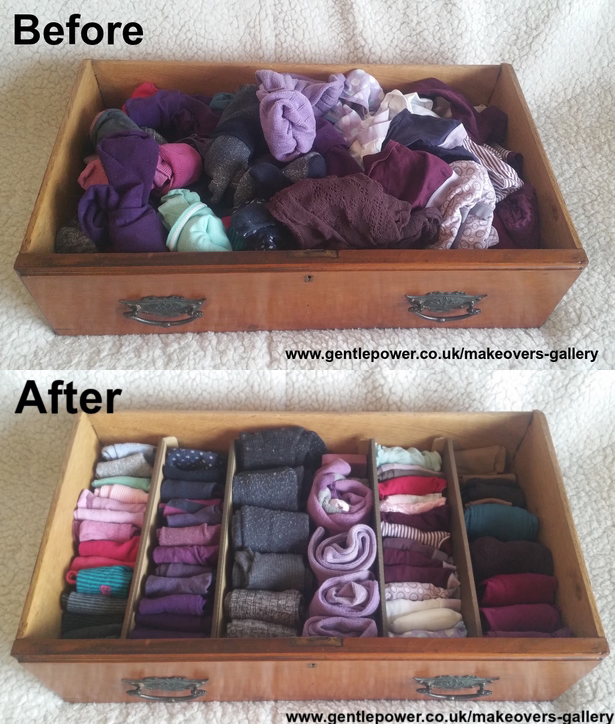
If you have a clear, user-friendly system for housing and using your belongings, a way of enjoying your space that’s both doable and authentic to you, that creates a structural holding.
Organising how you use your space holds your needs and activities in a given space, in a kind of supportive, sustainable order.
If you reduce your belongings but then use your living space in the same way you had done before, there is nothing preventing clutter from accumulating as it did before.
So instead of hopping on New Year Resolutions wagon or on the decluttering wagon, please delay your decluttering project until you find a way to also ORGANISE the belongings that you’ll be keeping.
3 things to clarify to stay clutter-free long term
If you want to STAY clutter free after decluttering, you need to clarify three things:
1. What is housed where.
2. What you do where.
3. Who is responsible for which “domain” (who stewards each area).
I offer organising as part and parcel of my empathic room makeovers and if your declutterer doesn’t, I’d like to encourage you to find another way of rethinking and reorganising your space on top of decluttering itself.
When you do that, you’ll have harnessed a great opportunity that comes with a “clutter problem”: to notice where your lifestyle needs adjusting and to learn what will bring more wellbeing to you.
If you don’t CLARIFY what better options look like, if you don’t set up your daily operations in a new way, you’ll revert to the old, poor ways just so that life is doable.
If you let it happen, old habits will become the way you orient ourselves in a new space thus beginning to revert to how life flowed in the old one.
Letting this happen would be a waste of energy and opportunity but I trust you now know better than to accept that.